

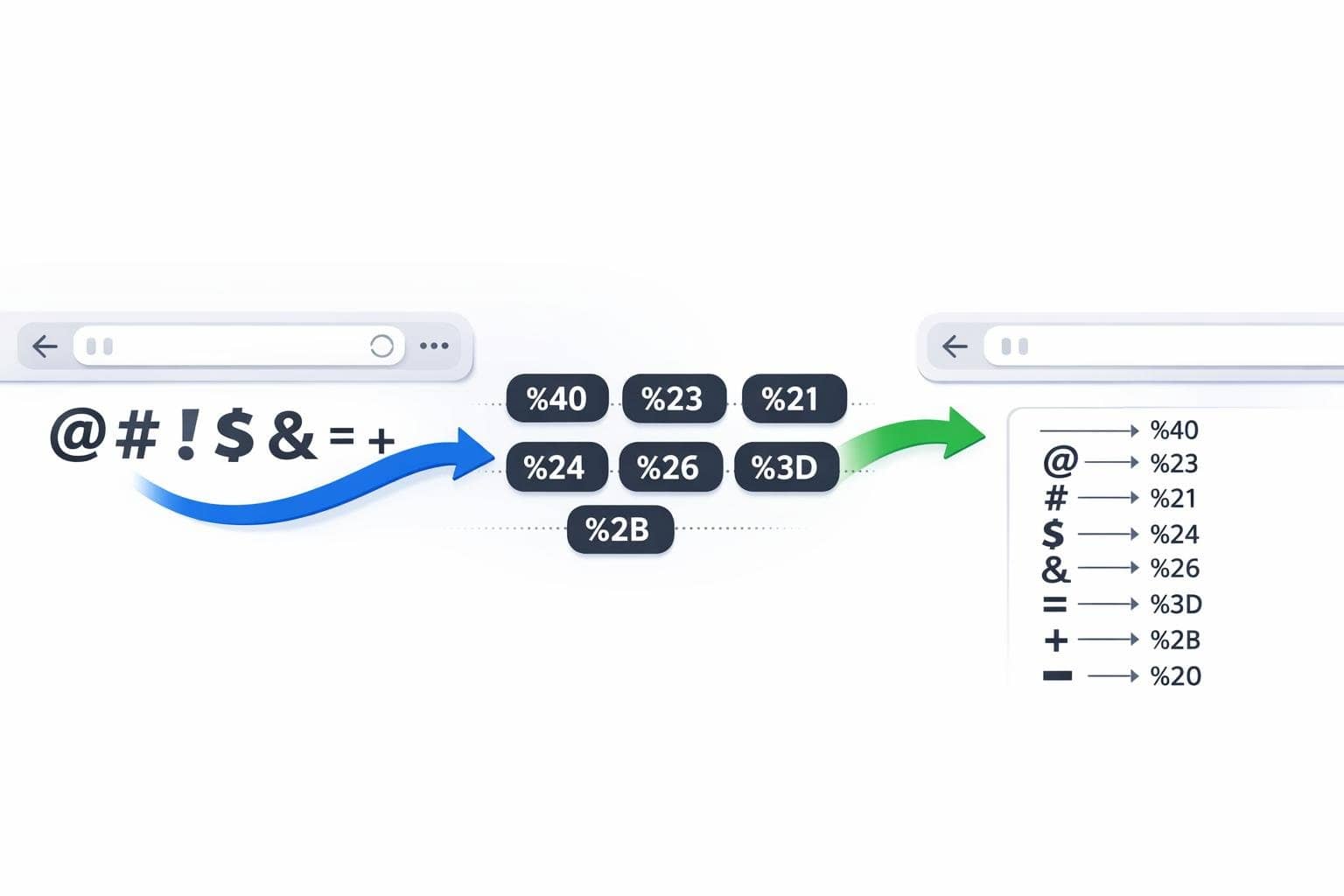
What is URL Encoding? Why Can't Spaces, Chinese Characters, and Special Characters Be Placed Directly in Links?
Many people first encounter URL encoding when they come across strings like %20, %2F, %E4%B8%AD%E6%96%87 in browser address bars, API parameters, or log files. These contents may look like garbled text, but they are not; they simply convert spaces, Chinese characters, or special symbols into a format that can be reliably transmitted via a URL.
The core purpose of URL encoding is to convert characters that aren't suitable for direct use in links into a safe, standardized representation. Characters like spaces, Chinese characters, special symbols, and reserved characters often need to be encoded before they can reliably appear in URLs.
This is also why URL Encoding/Decoding Tools remain continuously useful in development, operations, SEO, and data processing scenarios.
Quick Answer: What Does URL Encoding Do?
URL encoding converts unsafe or incompatible characters in URLs into a format that browsers and servers can reliably recognize. It's commonly used in search parameters, API requests, redirect links, log troubleshooting, and handling Chinese character URLs.
Why Can't URLs Contain Arbitrary Characters Directly?
Because URLs follow a specific set of syntax rules. Certain characters have special meanings within URLs, such as:
?indicates the start of query parameters&is used to separate parameters/indicates path hierarchy
If these characters are themselves part of the content, they need to be encoded before transmission, otherwise the system will misinterpret them.
Why do Chinese characters often turn into a long string of %E4...?
Because URLs ultimately need to be represented as specific byte sequences, and Chinese characters must first be converted to bytes, then written into the link using percent-encoding. This is not an error, but standard practice.
Who most commonly needs URL encoding/decoding?
- Frontend and backend developers
- People doing API debugging and log troubleshooting
- People who handle SEO paths and redirect links
- People who frequently copy, concatenate, and analyze Chinese URLs
Is URL encoding the same as Base64?
No, they are not. URL encoding addresses which characters cannot be directly placed in a URL,while Base64 is about how to safely represent binary data as text. Although both are called encoding, their purposes are completely different.
Who most commonly needs URL encoding/decoding?
- Frontend and backend developers
- People doing API debugging and log troubleshooting
- People handling SEO paths or parameter links
- People who frequently copy, concatenate, and analyze links
Why do we need an online tool?
Although it can be handled in code, often you just want to quickly verify a string, understand a parameter, or quickly copy the result. Using the URL Encoding Decoding Tool is more straightforward than opening a console or writing a script on the fly.
Frequently Asked Questions
1. Is URL encoding the same as Base64?
No. They solve different problems.
2. Why is a space sometimes %20 and sometimes +?
This depends on the specific context, especially in form encoding scenarios.
3. Does Chinese in URLs affect SEO?
Search engines can handle it, but many teams still decide whether to retain Chinese paths based on readability and sharing experience.
If you often handle API parameters, redirect links, Chinese addresses, or log content, you can try the O.Convertor URL Encoder and Decoder tool. If you also frequently encounter Base64 strings, you can check out What is the difference between Base64 encoding and encryption.